Learn · Tools
The best AI coding agents in 2026.
Not from spec sheets. We run these agents side by side, on the same repositories, every day. This is what holds up.
As of July 2026: Claude Code is the strongest all-round CLI agent for real repositories, Codex CLI is close behind and faster on surgical edits, Gemini CLI is the best free entry point, and Aider is the open-source pick. The right choice mostly follows the subscription you already pay for.
How we tested
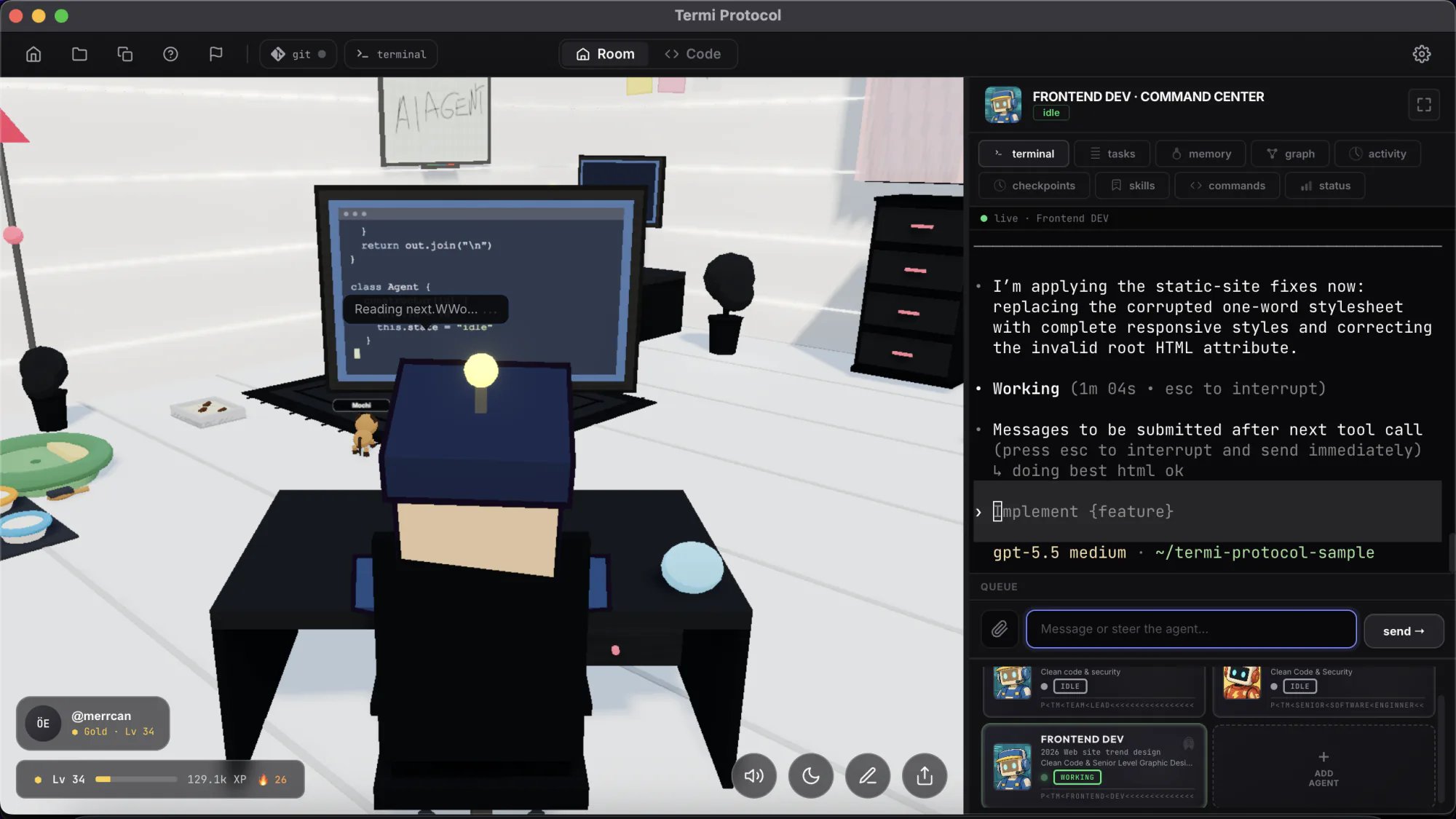
We build The Termi Protocol, a desktop workspace that runs CLI coding agents side by side in one 3D room. That gives us an unusual vantage point: we launch these agents dozens of times a day on the same codebases, and we watch every file read, every command and every diff they produce, because visualizing exactly that is our product. The notes below come from that daily use through mid-2026, not from vendor benchmarks. Models and pricing change fast; where a claim is time-sensitive we say "as of July 2026" and mean it.
What we weigh: repository awareness (does it find the right code without hand-feeding?), loop reliability (does it recover from its own errors?), autonomy controls (approvals, sandboxing), cost transparency, and how it behaves on long tasks.
The short version
| Agent | Maker | Access | Best at | Watch out for |
|---|---|---|---|---|
| Claude Code | Anthropic | Claude plans / API | Repo awareness, planning, hooks and subagents | Heavy token appetite on big tasks |
| Codex CLI | OpenAI | ChatGPT plans / API | Fast, surgical edits; solid sandbox modes | Thinner planning UX on long tasks |
| Gemini CLI | Free tier / API | Free allowance, huge context window | Loop steadiness on long sessions | |
| Copilot CLI | GitHub | Copilot subscription | GitHub-native workflows, PR flow | Agent mode younger than rivals |
| Aider | Open source | Any API key | Git-native diffs, model freedom | More manual steering required |
| opencode | Open source | Any API key | Polished TUI, multi-provider | Younger ecosystem |
| Grok CLI | xAI | Grok plans / API | Quick iterations | Thinner tooling ecosystem |
| Ollama + local models | Open source | Your hardware | Privacy, zero marginal cost | Quality gap on hard multi-file work |
Agent by agent
Claude Code
The one we reach for first on unfamiliar or messy repositories. It is the best at building an accurate picture of a codebase before touching it, its plans are worth reading, and the hooks system makes it the most extensible agent here (our own app listens to those hooks to animate every step). The trade-off is appetite: long sessions consume serious tokens, so cost visibility matters. Needs a paid Claude plan or API key to be useful.
Codex CLI
The fastest of the majors on well-defined tasks, and its sandboxing story (read-only, workspace-write, full access) is the cleanest way to control blast radius. When we know exactly what we want changed, Codex often lands it in fewer loops than anything else. On long, ambiguous tasks we find ourselves steering it more than Claude Code.
Gemini CLI
The generous free tier makes it the default answer to "I just want to try this agent thing." The giant context window genuinely helps on large files and sprawling monorepos. In our runs the tool loop wobbles more on long sessions than the top two: it occasionally re-reads what it already knows or stalls mid-plan. For the price, unbeatable.
Copilot CLI
If your team lives in GitHub, the integration is the argument: issues, PRs and reviews are first-class. The standalone agent mode has improved fast but is still younger than the top two, and it is happiest inside the GitHub workflow rather than as a general-purpose terminal agent.
Aider
The open-source veteran. Every change is a clean git commit, which enforces exactly the checkpoint discipline we preach, and it works with practically any model. It asks more of you: less autonomous planning, more explicit instruction. People who want to see and control everything love it for the same reason vibe-first users bounce off it.
opencode
The most polished terminal UI in the open-source field, multi-provider from day one, moving quickly. The ecosystem around it (extensions, integrations, community recipes) is still thinner than Aider's. Worth watching, and already a fine daily driver if you prefer open source.
Grok CLI
Quick, capable on everyday tasks, and the most personality per token. The tooling around it is thinner than the majors, so it shows up in our rooms as a second opinion more often than as the lead agent.
Local models via Ollama
Code never leaves your machine and marginal cost is zero, which for some codebases is the entire decision. Current local models handle scoped, single-file tasks respectably and still trail the frontier badly on hard multi-file refactors. Pair with Aider or opencode for the best experience.
Which one should you pick?
- You pay for Claude: Claude Code, no hesitation.
- You pay for ChatGPT: Codex CLI.
- You pay for nothing and want to start today: Gemini CLI.
- Your world is GitHub: Copilot CLI.
- Open source or nothing: Aider (battle-tested) or opencode (nicer UI).
- Code cannot leave the building: Ollama with a local model, driven by Aider or opencode.
Or stop choosing and run several
The dirty secret of this comparison is that the teams getting the most out of agents in 2026 do not pick one. They give the gnarly refactor to Claude Code, the quick fixes to Codex, the bulk scaffolding to Gemini, and sometimes have one agent review another's work. That has coordination problems (file collisions, cost sprawl, N terminals), which we wrote up in running multiple AI coding agents in parallel. It is also, not coincidentally, the exact problem our product exists to make visible: every agent above runs inside Termi, side by side, each with its own desk, checkpoints and live cost.
Run them all in one room
Termi works with Claude Code, Codex, Gemini CLI, Copilot, Aider and any CLI agent. One 3D room, every agent visible, checkpoints and cost per desk.